The Electric Motor’s Hungarian Origins
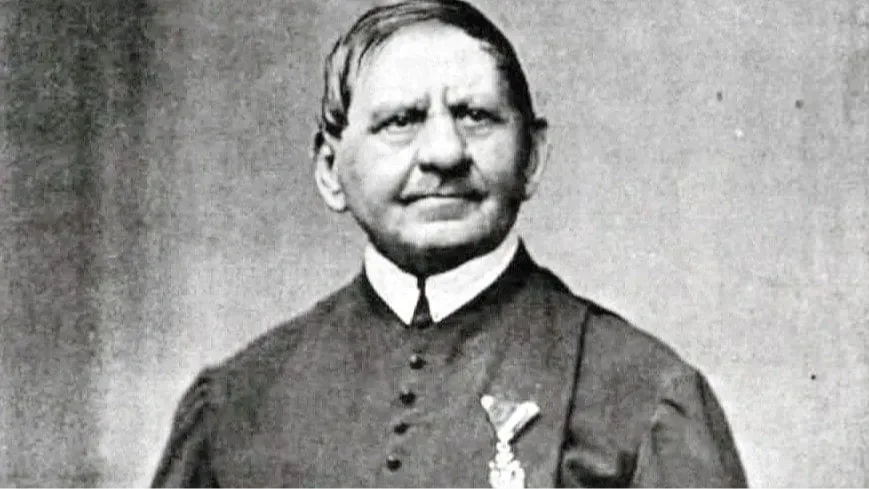 Dr Ányos Jedlik photographed by Ede Ellinger in 1896. Source: Wikimedia Commons
The electric motor appeared earlier than is commonly acknowledged in mainstream histories of science. While Michael Faraday demonstrated electromagnetic rotation in 1821 and received credit for developing electrical machinery, a Hungarian Benedictine monk named Ányos Jedlik had already begun experiments that produced working prototypes several years earlier than his British contemporary’s practical applications.
Born in 1800 in Szimő, Kingdom of Hungary, Jedlik became a Benedictine priest who also studied physics. This year marks the 226th anniversary of his birth. By 1827, he had constructed what he called an "electromagnetic self-rotor," a machine that turned electricity into motion. The apparatus used a commutator, a rotating switch, which enabled continuous rotation instead of the oscillating motion seen in earlier attempts. Faraday's 1821 device spun a wire around a magnet, but Jedlik's machine pointed toward practical motors.
This achievement contradicted prevailing assumptions of the time. Many scientists of the era believed electromagnetic forces could not sustain rotational motion. In a Győr classroom, Jedlik demonstrated otherwise, building a motor in which both stationary and rotating components were electromagnetic, without any permanent magnets. The device worked in 1828 and remains operational nearly two centuries later in Budapest's Museum of Applied Arts, a testament to early Hungarian engineering.
Geography played a decisive role in recognition.
Jedlik worked in relative isolation within institutions across Hungary, including Győr, Pozsony, and later the Royal Joseph University of Pest. His 1827 motor predated the first widely recognized self-excited electromagnetic motor by more than a decade. Yet distance from Western European scientific centers, combined with limited institutional networks, meant his breakthroughs circulated only narrowly beyond Hungary.
Jedlik's contributions extended beyond motors. He invented an early version of the dynamo in 1861 that could produce continuous electrical current on its own. When he submitted his findings to a German journal, Western European editors dismissed the Hungarian innovation, saying the idea wasn't new and readers wouldn't understand it. Discouraged, Jedlik ceased publishing abroad. Six years later, Werner von Siemens announced the identical principle without acknowledging Jedlik's prior work. Siemens received the credit, and Jedlik's contribution faded from international awareness.
His commitment to Hungary wasn't limited to his laboratory.
During the 1848-49 revolution, Jedlik joined the National Guard, digging trenches and standing sentry for Hungarian sovereignty. From 1848 onward, he became the first professor at the Royal Pest University to lecture in Hungarian rather than Latin, breaking centuries of tradition. He helped establish Hungarian scientific vocabulary, including dugattyú (piston), huzal (wire), and nyomaték (torque), terms Hungarian engineers and students still use today.
By the 1850s, as Siemens and others built industrial-scale electric motors, Jedlik turned increasingly to teaching and to other experiments. The Hungarian Academy of Sciences recognized his achievements in 1858, electing him directly to full membership and bypassing the usual correspondent status. He never patented his motor designs. "I am not a manufacturer, but a teacher," he said when colleagues urged him to protect his inventions. His work remained little known outside Central Europe until the early 20th century, when historians began to reexamine the development of electrical technology.
Scientific progress does not unfold evenly. Jedlik had no network of industrialists to commercialize his inventions, no Royal Society to amplify his findings, and no empire to fund large-scale applications. He conducted experiments in university workshops with hand-built equipment, documented his results in ledgers, and lived to see the electrical revolution he helped initiate before dying in 1895, largely without recognition.
Hungary now honors Jedlik with statues, named institutions, and currency. His electromagnetic self-rotor sits in museums, evidence that more contributors shaped electrical engineering than conventional narratives admit. The monk who wound copper coils and aligned magnets in a Pest laboratory helped create technology found on factory floors and inside smartphones, yet most people who benefit from his work have never heard his name.
Sources:
Vasárnap.hu - "A feltaláló bencés szerzetes"
https://vasarnap.hu/2025/01/11/a-feltalalo-bences-szerzetes-akinek-a-villanymotort-es-a-szodavizet-is-koszonhetjuk-225-eve-szuletett-jedlik-anyos/
Magyar Kurír - "217 éve született Jedlik Ányos"
https://www.magyarkurir.hu/hirek/217-eve-szuletett-jedlik-anyos






Mi a munkánkkal háláljuk meg a megtisztelő figyelmüket és támogatásukat. A Magyarjelen.hu (Magyar Jelen) sem a kormánytól, sem a balliberális, nyíltan globalista ellenzéktől nem függ, ezért mindkét oldalról őszintén tud írni, hírt közölni, oknyomozni, igazságot feltárni.
Támogatás