Zoltán Tarr on the Red Army as “Liberators”
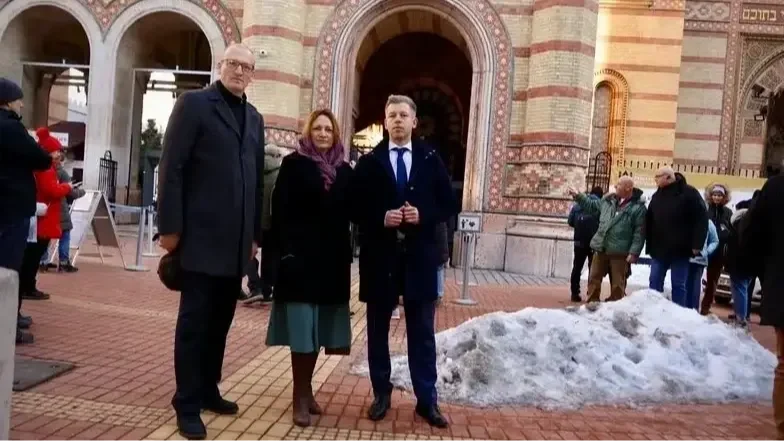 Photo: Zoltán Tarr’s Facebook page
Translation of an article originally published in Hungarian by Magyar Jelen on January 18, 2026 by Dániel Irányi.
Hungary has never quite managed to settle on a single way of remembering its past. Even today, we find ourselves in a familiar place. For many Hungarians, the fall of Budapest, the occupation of the country, the deportation of nearly one million compatriots to the Gulag, and the mass violation of women, children, and mothers remain a national tragedy, one that set the stage for the country’s long subjugation. Others, however, continue to describe the Soviet forces that advanced across Europe as “liberators.”
Zoltán Tarr belongs to the latter group. On yet another Holocaust memorial day, he wrote the following on his Facebook page:
“Eighty-one years ago, the nightmare of the Budapest ghetto came to an end. On January 18, the Red Army liberated the ghetto into which the Arrow Cross regime had forced nearly 70,000 Hungarian citizens, confined within walls, without food or medicine, stripped of their human dignity, during one of the coldest winters of the 20th century. By then, nearly three thousand people had lost their lives. Today, we bowed our heads at the commemoration of the Budapest Jewish Community, there where the garden of the Dohány Street Synagogue became a mass grave.”
This is the same man whom we have never seen bow his head before a single heroic Hungarian soldier. Yet here he appeared close to tears while reciting poems, before adding that “this was one of the darkest chapters of Hungarian history” and that “it was our shared responsibility not to forget it and not to relativize it.”
Anyone encountering only this post, without much familiarity with Hungarian politics, might reasonably assume they had wandered onto the page of a Fidesz politician. Tarr, now a European Parliament representative for the Tisza Party, repeated almost verbatim the government’s well-worn formulas. There is “zero tolerance for all forms of antisemitism.” The security of Hungary’s Jewish community is “non-negotiable.” Remembrance is “not a one-time gesture but a continuous moral duty.”
He also made it clear that, in his view, wherever crimes against humanity are silenced or quietly smoothed over, the foundations of democracy begin to crack. It is unfortunate, then, that during the massacres in Gaza, Mr. Tarr seems to have misplaced this concern. On that occasion, he remained just as silent as he once did about the Red Terror.
His inner “humanist,” it appears, emerges selectively.
Interesting how these things work.
Az X- és Telegram-csatornáinkra feliratkozva egyetlen hírről sem maradsz le!





Mi a munkánkkal háláljuk meg a megtisztelő figyelmüket és támogatásukat. A Magyarjelen.hu (Magyar Jelen) sem a kormánytól, sem a balliberális, nyíltan globalista ellenzéktől nem függ, ezért mindkét oldalról őszintén tud írni, hírt közölni, oknyomozni, igazságot feltárni.
Támogatás