The Night Hungary’s Vitamin C Discovery Won a Nobel Prize
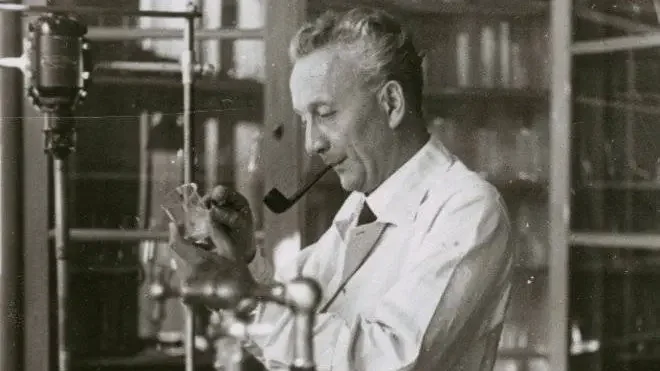 Photo: Múlt-kor! Magazine
The orchestra played the Rákóczi March as Albert Szent-Györgyi stepped forward to receive the 208-gram gold medal from King Gustav V of Sweden. It was December 10, 1937. Hungarian radio broadcast the ceremony live from the Stockholm Concert Hall, and the whole country listened. Hungary had received its first Nobel Prize in the natural sciences.
A professor of chemistry from the Karolinska Institute had addressed him moments earlier: “You and your colleagues in Szeged have made exceptional progress. Your results are genuinely new and extraordinarily important. You are the devoted scientist and brilliant discoverer envisioned by Alfred Nobel. I ask you, Professor Szent-Györgyi, to receive the prize from our gracious king.”
Szent-Györgyi was 44. He had arrived in Stockholm with his wife, his daughter Nelli, and the Hungarian ambassador. The telegram announcing the prize reached Szeged on October 28. The next morning, he visited Kuno Klebelsberg’s tomb in the cathedral in Szeged. Klebelsberg had invited him back to Hungary in 1928. He was confident that with support from the Rockefeller Foundation, known at the time mainly for strengthening scientific institutions rather than for the ideological aims associated with it today, Szeged could become a center of scientific life.
The Nobel Prize recognized his discoveries in cellular combustion processes, particularly vitamin C and the catalysis of fumaric acid.
But the breakthrough had come from an unlikely source. His wife served paprika with dinner one evening in 1932. Szent-Györgyi brought the Hungarian pepper to his laboratory rather than eating it. His team extracted 6.5 grams of hexuronic acid from 10 liters of paprika juice. Paprika grown around Szeged contained unusually high concentrations of vitamin C, and unlike oranges and lemons, its low sugar content made the compound far easier to isolate.
Joseph Svirbely, a young Hungarian American researcher from Charles King’s laboratory in Pittsburgh, worked with him to show that hexuronic acid and vitamin C were the same compound. Szent-Györgyi announced this at a meeting of the Budapest Royal Society of Physicians in mid-March 1932. The Hungarian Medical Journal published the identification a week later.
His research extended beyond vitamin C. His investigations into cellular respiration had identified fumaric acid and other organic compounds essential to energy production. Hans Krebs built on this work and two years later completed what came to be known as the citric acid cycle.
Born in Budapest in 1893, Szent-Györgyi was born into the Szent-Györgyi de Nagyrápolt family. His mother’s Lenhossék relatives had produced generations of prominent researchers. He graduated from the Lónyay Street Reformed High School and entered medical school. World War I interrupted his studies. Serving as a medic, he earned the Silver Medal for Valor, but the brutality of the war left him deeply disillusioned. He ended his service in 1916 after suffering a wound to his arm. He returned to Budapest and finished his medical degree in 1917.
By the time he stood in Stockholm, the hardships of war and years of research lay behind him. After the Stockholm ceremony, chauffeured cars moved through heavy snowfall toward City Hall. Three hundred guests attended the banquet in the Golden Room, decorated with thousands of flowers that San Remo had donated in memory of Alfred Nobel. Szeged later named him an honorary citizen, and he served as university rector during the 1940–1941 academic year.
Szent-Györgyi brought the gold medal back to his laboratory in Szeged. When the Soviet Union attacked Finland in 1939, he donated it to support the Finnish people during Hungary’s relief campaign.
Count István Zichy, who directed the Hungarian National Museum, arranged for Wilhelm Hilbert to purchase the medal from the Finnish relief committee. Hilbert was a Helsinki business executive with Hungarian connections. He delivered it to the museum in Budapest in the summer of 1940.
Szent-Györgyi thought the medal was lost. The museum first displayed it publicly in 1993, on the centennial of his birth. The 66-millimeter medal bears the inscription “A. von Szent-Györgyi / MCMXXXVII” on its reverse.
He died in Woods Hole, Massachusetts, on October 22, 1986. The Szeged Medical University adopted his name the following year. His medal remains at the Hungarian National Museum.
Sources:
• University of Szeged Klebelsberg Library and Archives
• Behir.hu
• Hungarian National Museum
• National Intellectual Property Office of Hungary




Mi a munkánkkal háláljuk meg a megtisztelő figyelmüket és támogatásukat. A Magyarjelen.hu (Magyar Jelen) sem a kormánytól, sem a balliberális, nyíltan globalista ellenzéktől nem függ, ezért mindkét oldalról őszintén tud írni, hírt közölni, oknyomozni, igazságot feltárni.
Támogatás