Holy Crown of Hungary Comes Home After Decades Abroad
 Source: PestBuda
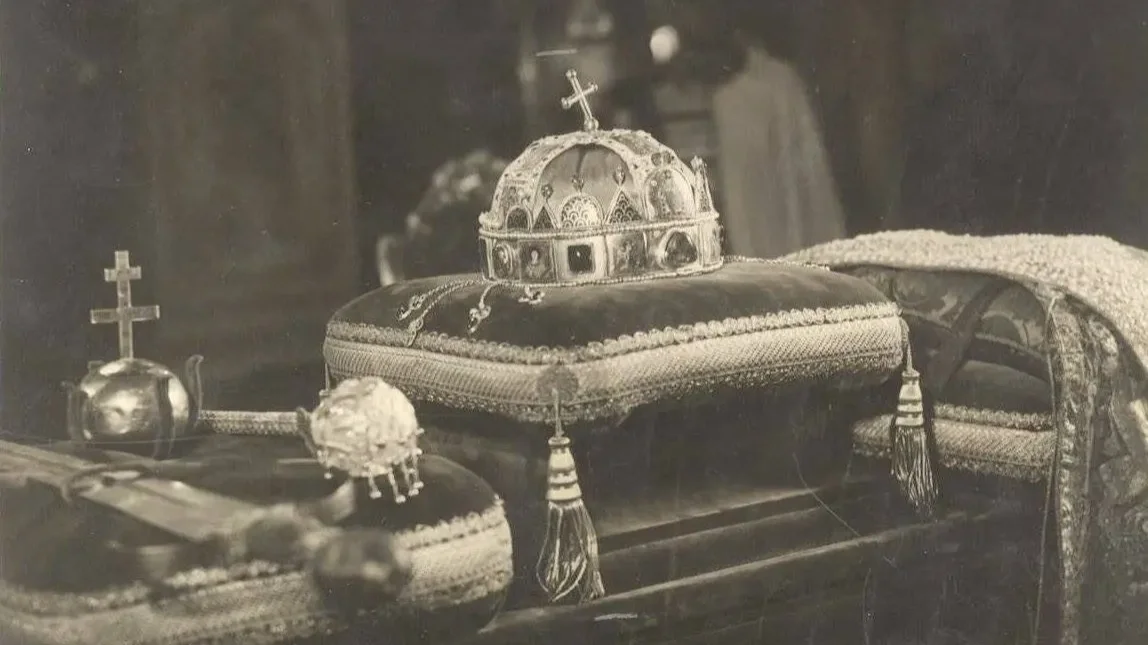
Air Force Two landed at Ferihegy Airport on a January evening in 1978. The aircraft carried the Holy Crown of Hungary in its worn wooden chest, along with the scepter, orb, and coronation sword. These objects had represented legitimate authority in the Kingdom of Hungary for centuries, embodying a Christian constitutional order that communist ideology explicitly sought to dismantle.
Cyrus Vance, the United States Secretary of State under President Jimmy Carter, led the American delegation. On the afternoon of January 6, he stood in the domed hall of the Hungarian Parliament and formally handed over the crown to Antal Apró, Speaker of the National Assembly.
Apró had been a senior figure in the communist party leadership and was instrumental in facilitating the Soviet invasion of Hungary, which subordinated the nation’s historic Christian order to atheist state power. He had overseen the violent suppression of the 1956 Hungarian uprising and played a key role in coordinating the regime’s violent response with Soviet forces, against a population demanding national sovereignty and constitutional self-rule. In 1958, he appeared before parliament to sanction the regime’s campaign against the 1956 freedom fighters, helping legitimize executions, imprisonments, and the systematic destruction of the resistance.
The crown’s return, carried out in the presence of figures such as Apró, ended its longest exile and closed a diplomatic stalemate dating to 1945, while placing a sacred national symbol within a state that denied the very source of its authority.
That moral dissonance had its roots in the final months of World War II, as Soviet forces pressed westward into Hungary and imposed their control. Crown Guard Commander Ernő Pajtás led a small unit out of Budapest with the regalia in March 1945, seeking to preserve the crown from capture by occupying powers hostile to its sacred role. They passed through Veszprém and Kőszeg before crossing into Austria. Near Mattsee in late April, the guardsmen buried the crown and the other jewels in a cut fuel drum. They left the coronation mantle in the care of a local priest.
American soldiers discovered the cache in late July after interrogating captured members of the Crown Guard. The artifacts were moved through occupied Germany before crossing the Atlantic in 1953. They were stored at Fort Knox, the same Kentucky fortress that held the United States’ gold reserves, far from the nation whose spiritual and legal identity they embodied. A State Department officer inspected the regalia annually.
Cardinal József Mindszenty opposed returning the crown. Imprisoned and tortured by the communist regime before 1956, he later spent fifteen years confined to the American embassy in Budapest after the uprising, becoming a living symbol of the Church’s subjugation under communist rule. In 1964, he wrote to President Lyndon Johnson, asking him to safeguard the crown. He described it as a gift from Pope Sylvester II to King Stephen I of Hungary, later canonized as Saint Stephen, who was crowned at the turn of the millennium in 1000–1001.
According to Hungary’s historic legal doctrine, sovereignty resided not in rulers, parties, or assemblies, but in the Holy Crown itself, rendering communist rule illegitimate from its inception. The regalia had been in American custody for thirty-three years, while its homeland was ruled by a system hostile to its meaning.
Mindszenty feared that returning the crown would legitimize communist authority. Handing Hungary’s most sacred symbol to those who had crushed the 1956 uprising, and who since 1945 had ruled through executions, mass imprisonments, forced collectivization, deportations, and the systematic destruction of civil and religious institutions, would, in his view, do precisely that. Hungarian-American communities shared these concerns. Many were refugees from both the immediate postwar terror and the reprisals that followed 1956, and they regarded the crown as a symbol that transcended any government in Budapest.
President Jimmy Carter took a different position. His administration treated the issue as one of national heritage rather than political validation, a distinction that ignored how inseparable the crown’s meaning was from Hungary’s Christian statehood. The crown belonged to the Hungarian people, Carter argued, not to whichever regime governed them. Negotiations moved forward from that understanding.
The debate soon shifted to Washington, far from a Hungary where public dissent remained impossible. Congress held hearings, where witnesses testified about religious persecution and questioned whether János Kádár’s government deserved recognition. Robert Dole filed legal challenges, but the Supreme Court declined to hear them. By December 1977, the two governments reached an agreement. The crown would be returned to the Hungarian people in a public ceremony, without any opportunity for the people themselves to consent or object.
The Hungarian émigré community split sharply over the decision. Új Látóhatár, Katolikus Szemle, and Magyar Híradó in Vienna supported the return, arguing that the crown would strengthen Hungarians in their faith and perseverance. Others strongly opposed it. The New Yorki Magyar Élet published angry denunciations, and émigré leaders used their congressional connections in an effort to block the transfer. Despite the controversy, preparations for the return continued, over the protests of those who had escaped communist persecution and exile.
Hungarian experts Éva Kovács and Joachim Szvetnik traveled to Fort Knox in December to authenticate the regalia and supervise its preparation for transport. Vance assembled a delegation that included Senator Adlai Stevenson, Congressman Lee Hamilton, and Nobel laureate Albert Szent-Györgyi. Radio Free Europe broadcast from Budapest for the first time, covering the handover live, allowing Hungarians to witness an event otherwise tightly controlled by the state.
Kádár stayed away from both the airport reception and the parliamentary ceremony. American diplomats deliberately kept distance between the crown’s return and any appearance of endorsing communist authority, even as the regime sought to claim symbolic ownership of the moment. Hungarian television delayed its broadcast of the ceremony by two hours, allowing officials time to review Vance’s remarks before airing them.
Once the political ceremony ended, attention returned to the crown itself, whose meaning had outlasted regimes, decrees, and ideology.
Conservators documented damage it had sustained over centuries of use and concealment. The coronation sword had been ruined when it was buried near Orsova during the 1849 revolution and was later replaced. The tilted cross atop the crown remained unchanged. Tradition holds that it bent when the crown’s storage chest was hastily closed.
The Hungarian National Museum opened its exhibition on January 31, 1978. Nearly two million visitors attended in the first two years, suggesting a popular reverence that outlasted decades of ideological reeducation. In 2000, parliament voted to move the crown and most of the regalia to the central rotunda of the legislative building, where they remain under guard today.
The symbolic reconciliation was followed by practical consequences. Trade between Hungary and the United States expanded after the return. Budapest gained Most Favored Nation status, tariffs were reduced, and new commercial ties were established. During the Cold War’s final decade, Hungary began a gradual departure from strict Soviet alignment, as communist authority slowly weakened across Eastern Europe.
Historians have since examined the crown’s journey as an example of political symbolism, and of a sacred tradition surviving repeated attempts at eradication. Byzantine artisans crafted the enamel work in the 1070s, and it was later mounted with a Latin superstructure. Over 135 years, the crown made eleven journeys abroad and returned each time. More than fifty Hungarian kings wore it after the Middle Ages. Hungarian legal doctrine placed sovereignty in the crown itself rather than in any individual ruler. According to tradition, King Stephen offered Hungary to the Virgin Mary through the crown on the day before his death in 1038, making her both patron saint and queen of the kingdom.
The crown’s location mattered throughout Hungarian history. Possession gave legitimacy to claimants to the throne, while its absence raised doubts about a ruler’s authority. The 1978 return took place in a country that had abolished the monarchy three decades earlier, by a regime that rejected the crown’s spiritual foundations. Yet nearly two million Hungarians visited the crown during its first two years on display. National identity had endured despite decades of communist rule. The émigrés who sought to preserve that continuity helped ensure that it survived.
Sources
Hungarian Academy of Sciences
Research Centre for the Humanities, Institute of History, Lendület Holy Crown Research Group
Hungarian National Museum
Institute for Hungarian Research
Mult-kor
PestBuda

Mi a munkánkkal háláljuk meg a megtisztelő figyelmüket és támogatásukat. A Magyarjelen.hu (Magyar Jelen) sem a kormánytól, sem a balliberális, nyíltan globalista ellenzéktől nem függ, ezért mindkét oldalról őszintén tud írni, hírt közölni, oknyomozni, igazságot feltárni.
Támogatás